Research
Field Crop Research Division


 To improve the efficiency of farmland in response to climate change and to develop varieties that meet consumer demand, we are conducting research on double-cropping systems and the cultivation of short-season, low-carbon rice for processing.
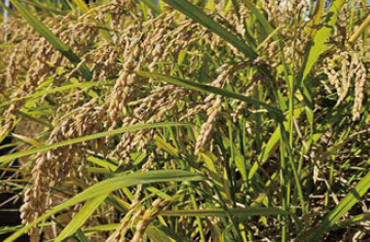
To improve the efficiency of farmland in response to climate change and to develop varieties that meet consumer demand, we are conducting research on double-cropping systems and the cultivation of short-season, low-carbon rice for processing. - Development of world’s first low-carbon rice variety ‘Gamtan’
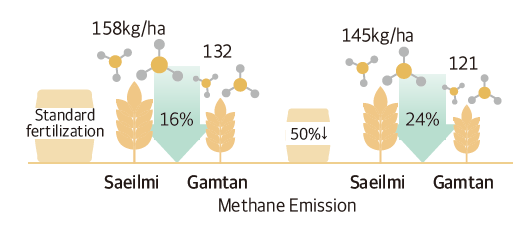
- Low fertilizer input (4.5kg/10a) with minimal yield reduction, reduced methane emission, suitable for eco-friendly agriculture
- Methane reduction: ~16% by variety alone, ~24% with 50% fertilizer reduction
- Conventional varieties with 50% fertilizer reduction → 15~20% yield loss, 'Gamtan' → 7% yield loss
- 'Gamtan''s cooking quality is superior to 'Samkwang', with multiple disease resistance, suitable for eco-friendly farming
- Low fertilizer input (4.5kg/10a) with minimal yield reduction, reduced methane emission, suitable for eco-friendly agriculture
- Expanding the development and dissemination of processed rice varieties to revitalize the processing industry
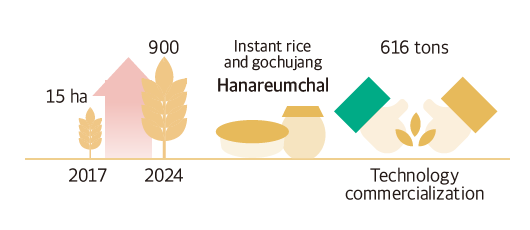
- Instant rice and gochujang: 'Hanareumchal' industrialization with CJ Breeding Co., Ltd.
- Developed and commercialized the rice variety 'Juhyangmi', optimized for distilled spirits production
- Pilot product manufacturing and promotion of 'Juhyangmi' with Hite Jinro Co., Ltd.
- Development of varieties for double-cropping systems to increase farmers' income
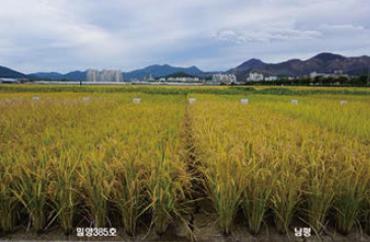
- Development of the early-maturing rice variety 'Neuldam' which is a garlic and onion-fertilizing strain
- Yield: 446 kg/10a, short-term, lodging, seed germination, and disease resistance
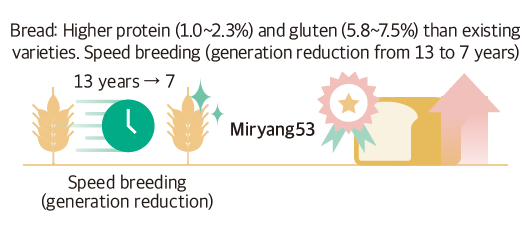
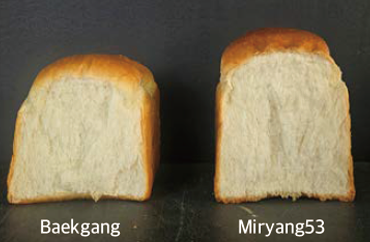
- Development of the first hard wheat variety, 'Miryang53' utilizing speed breeding (generation reduction from 13 to 7 years) in Korea (selected for the 2023 Top 100)
- Development of the early-maturing rice variety 'Neuldam' which is a garlic and onion-fertilizing strain
- Development of a double-cropping system to enhance arable land utilization efficiency
- Development of a double-cropping system technology for producing high-quality hard wheat
- Wheat-soybean cultivation increases wheat protein and gluten content compared to wheat-rice cultivation, improving processing suitability
- Development of alternative crop cultivation technologies (mung bean and buckwheat) to address flood damage in rice paddies and soybean fields
- Sowing possible until late August in the southern region
- Development of a double-cropping system technology for producing high-quality hard wheat