Research
Crop Breeding Division


 We are developing high-quality and stable rice varieties to strengthen the rice industry and ensure food security, while advancing precision and predictive digital breeding technologies.
We are developing high-quality and stable rice varieties to strengthen the rice industry and ensure food security, while advancing precision and predictive digital breeding technologies. - High-quality rice – development and dissemination of rice varieties with enhanced tolerance to environmental stresses and resistance to diseases and pests caused by climate change
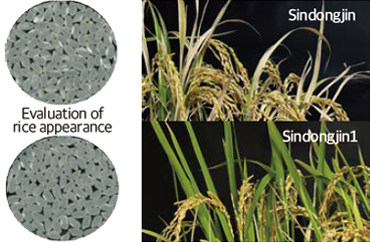
- (Sindongjin1) Derived from 'Sindongjin', the representative rice variety of Jeonbuk Province, with improved disease resistance and maintains grain quality under high temperatures → Contributing to the enhancement of regional rice brand value and competitiveness.
- Maintained the medium-large grain type and eating quality of 'Sindongjin', with enhanced resistance to bakanae disease and bacterial leaf blight. Produces clear and translucent grains with improved milled rice rate
- (Joongwonjinmi) Multiple resistance to major diseases and pests (Brown planthopper, bacterial leaf blight, etc). Developed in collaboration with Chungju City. Mid-maturing variety
- Differentiated variety developed to replace foreign cultivars in Chungju region with strong resistance to diseases and pests, good eating quality, and high straw yield
- (Sindongjin1) Derived from 'Sindongjin', the representative rice variety of Jeonbuk Province, with improved disease resistance and maintains grain quality under high temperatures → Contributing to the enhancement of regional rice brand value and competitiveness.
- Floury rice – Accelerating the development of flour-type rice varieties to address challenges in food processing and agricultural sector
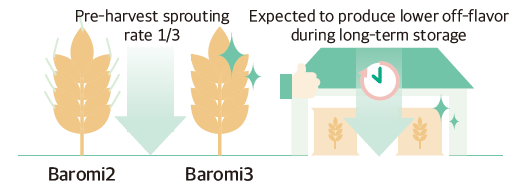
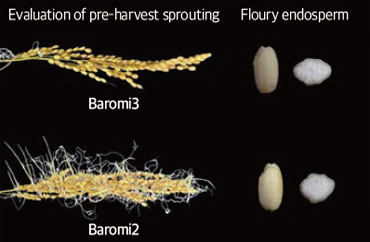
- (Baromi3) Pre-harvest sprouting reduced to 1/3 of 'Baromi2', expected to show lower off-flavor during long-term storage
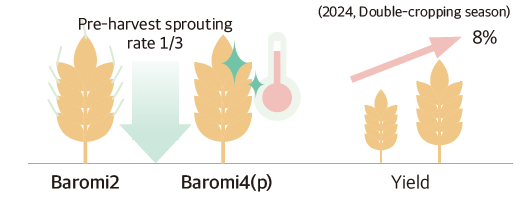
- (Baromi4(p)) Stable during high-temperature seedling stages, with a pre-harvest sprouting reduced to 1/3 of 'Baromi2', and yield increased by 8%
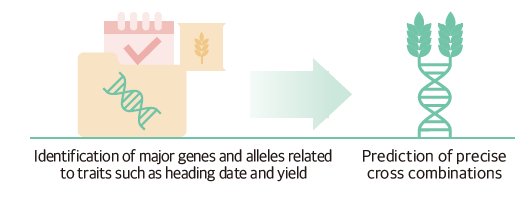
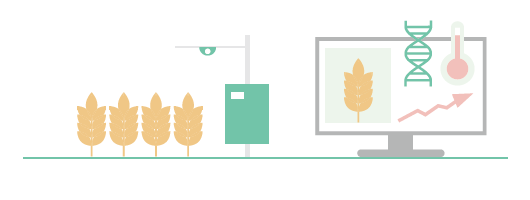
- Digital Breeding –Developing Precision and Predictive Breeding Technologies for Rapid Response to Changes in the Rice Industry
- (Predictive Model) Development of big data–based predictive models for key agronomic traits(in collaboration with the National Institute of Agricultural Sciences)
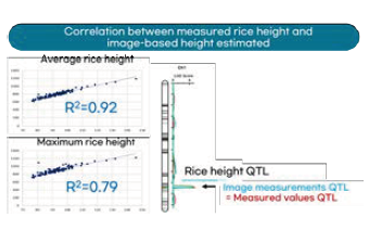
- (Phenotype) Application of image-based agronomic trait analysis in breeding, with standardization of growth data incorporating weather information
- (Genotype) Establishment of a large-scale analysis system for 95 molecular markers associated with key traits such as quality(in collaboration with the National Institute of Agricultural Sciences)